

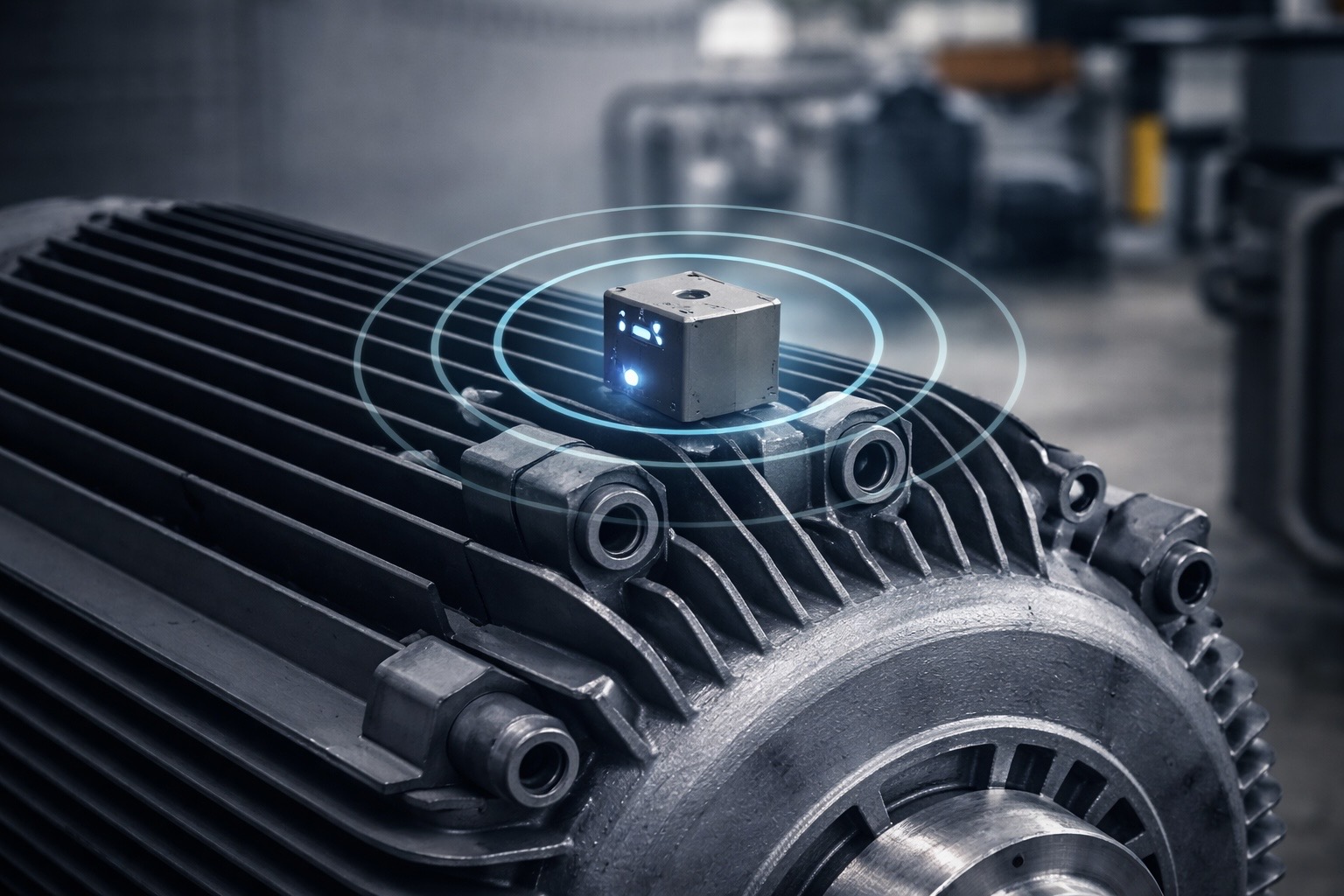
See the warning while the machine is still running.
Interpret drift against the baseline.
Operating Brief
Most motor failures leave evidence. The question is whether anyone is reading it.
Problem
Reactive maintenance begins after a failure the machine already announced — in vibration, in heat, in drift.
System
Establish behavioral baseline. Monitor continuously. Surface deviation before it stops the line.
Scope
Pilot-scale deployments on real compressors and pumps in operating industrial facilities.
The System
Baseline → Drift → Surface.
A tighter decision loop built on machine behavior — not gut instinct, not threshold alarms, not periodic inspection.
Capture behavioral baseline
Profile how the machine operates under its actual load conditions. Generic assumptions are not baselines — they are guesses with no reference point.
Monitor drift continuously
Every operating hour adds to the record. Drift shows in accumulated data well before it manifests as physical symptoms or unplanned downtime.
Surface deviation before the stop
When readings diverge from the established pattern, the system surfaces it — while there is still time to schedule investigation, not react to damage.
What the System Reads
01
Vibration
Vibration carries the earliest warning. Imbalance, looseness, bearing wear, and structural instability all announce themselves in frequency and amplitude change — across days or weeks, not minutes.
02
Temperature
Thermal drift is a direct indicator of friction increase, lubrication degradation, electrical resistance changes, and abnormal load behavior.
A single reading has limited meaning. The intelligence is in the pattern — what changed, at what rate, against what established baseline, over what duration.
From Research
Field observations that build the technical case.
Research at Dein Ø'Lynn is not content marketing. It is the record of what we observe when equipment runs under monitored conditions — baseline profiles, drift events, failure signatures, and the interpretation methodology behind every finding.
Explore ResearchPilot Program
Scoped deployments. Real equipment. Documented findings.
A pilot is not a proof-of-concept demo. It is a defined observation period on specific equipment — compressors, pumps, or other motor-driven systems — with a clear question at the start and documented output for the people who make maintenance decisions.
Pilot Structure
Phase 01
Baseline capture and operating profile
Phase 02
Continuous behavioral monitoring across vibration and temperature
Phase 03
Anomaly review and drift interpretation
Phase 04
Findings report for operational decision-makers
Systems
The infrastructure offer.
The full commercial offer — deployment model, operating methodology, and what the system is built to solve for motor-driven facilities.
View SystemsField Notes
The public record.
Writing grounded in machine behavior, field observations, and operational thinking — not content marketing.
Open Field NotesBuilders
The technical community.
Build logs, engineering documentation, and contributor work that sits beneath the company's operational intelligence layer.
Open Builders